Christmas markets, the noisy heart of winter
One thing Europe absolutely owns is the winter market scene. And they deserve their reputation. Germany alone turns into a country of glowing wooden stalls, mulled wine pots, roasting nuts, and kids running around in wool hats. Cologne, Munich, Nuremberg, Dresden, Berlin, Leipzig, so many places it’s impossible to count. But it’s not just Germany. Vienna polishs its squares like jewelry. Strasbourg turns into what locals casually call the capital of Christmas. Prague mixes gothic towers with sweet pastries filled with cinnamon. Even smaller towns, the ones with three streets and a sleepy river, hang lights as if the whole world is watching.
Markets bring people outside even when they probably should stay warm at home. There’s something addictive about standing in the cold with a hot drink in your hands, chatting with strangers, eating sausages you swore you didn’t want. And it isn’t just shopping. It’s community. It’s tradition. It’s winter dressed up for visitors.
The quiet charm of cities under the cold
Some European cities feel almost built for winter. Copenhagen has that calm Nordic glow, with candles in windows and cafés that practically bully you into sitting down for something warm. Stockholm mixes frozen bays with brightly painted buildings that mirror off the ice. Helsinki feels bold and stark, in a beautiful way, with saunas offering refuge every few blocks.
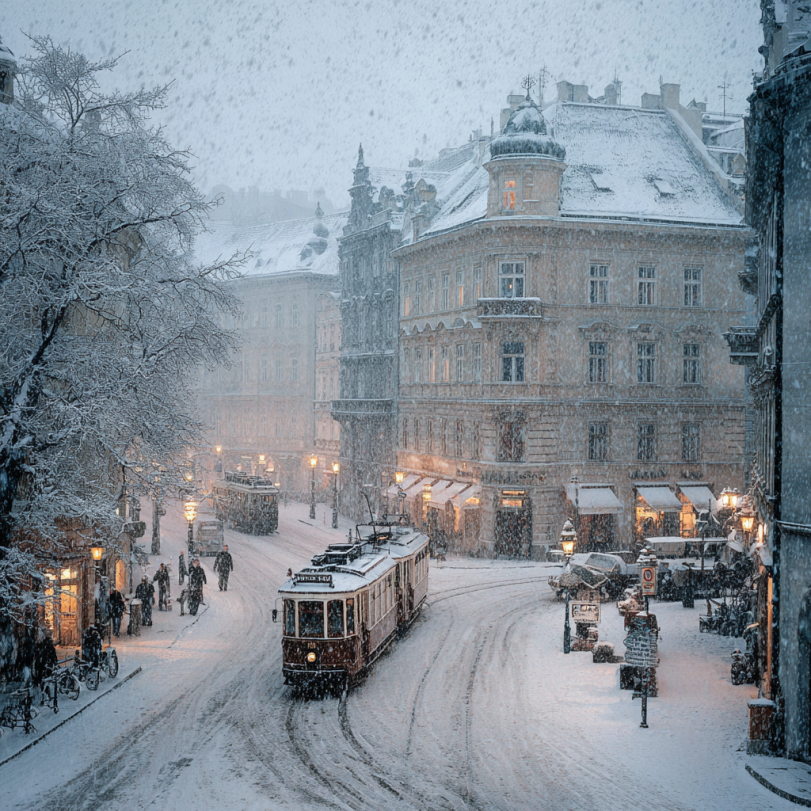
Central Europe delivers its own version. Budapest’s thermal baths steam like scenes from another world. Vienna feels elegant and a little old-fashioned, like it wants to show you what royal winters looked like a century ago. Prague becomes darker, moodier, and almost too photogenic for its own good.
Then there’s Paris. Winter softens the city. It removes a layer of tourist chaos. Bridges appear sharper under gray skies, cafés feel more intimate, and the Eiffel Tower looks less like a postcard prop and more like a steel giant keeping watch over the quiet season. London joins this mood too, with fog that rolls in like a movie effect and streets glowing wet from drizzle. Honestly, winter suits both cities more than they admit.
Ski slopes and snowy escapes
Of course winter in Europe isn’t only about cities. The Alps rise across France, Switzerland, Austria, and Italy like a spine of white peaks that travelers chase every year. Ski towns vary wildly. Some are fancy with long coat style and champagne everywhere. Others are tiny, with old wooden chalets and local bars that smell like cheese and firewood. But everywhere you go, the mountains feel timeless.
Skiing here isn’t only for experts. Many slopes are gentle, wide, and perfect for beginners who fall every 15 meters but still have fun. And the food on the mountains is somehow always better than you expect. Hot chocolate that tastes too good, soups that bring you back to life, cheese dishes heavy enough to anchor a small boat.
If skiing isn’t your thing, winter hiking, sledding, snowshoeing, or even just sitting in a cabin watching snowfall are all part of the Alpine menu. The Dolomites in Italy add their own twist with those tall, dramatic rock walls that turn pink during sunset. Norway offers deep fjords and quiet trails. Iceland offers pure drama, raw and windy, with geothermal pools waiting like little miracles in the cold.
Food that tastes better in winter
Winter in Europe belongs to comfort food. Big portions. Heavy plates. Warm spices. Stuff that makes you feel instantly less cold. In France you get onion soups that come out bubbling, tartiflette loaded with cheese and potatoes, pastries that seem to multiply during winter. In Germany you get sausages in all shapes, pretzels thicker than your arm, gingerbread sweet enough to distract anyone. In Hungary there’s goulash, thick and perfect for freezing days. Italy brings risottos and stews and hot espresso that seems to fix everything.
And then there’s mulled wine. Every country has its own style, sometimes too sweet, sometimes strong enough to sneak up on you. In Scandinavia it’s glögg, and they like adding almonds and raisins. In Germany it’s glühwein. In the UK it’s mulled wine but served with that familiar British shrug, like they know it works even if they won’t brag.
The unexpected beauty of the off season
Winter is the season that reveals a different Europe. It’s cheaper, quieter, sometimes friendlier. Locals aren’t as tired of tourists. Hotels drop their prices. Lines disappear. It’s easier to simply exist in a place without rushing through it.
This is also when small details matter. A cup of coffee by a window while snow falls outside. A nearly empty museum where you can stare at a painting without being elbowed every five seconds. A morning walk through a cold village where you can hear every footstep. Europe shows a softer personality in winter, slower, more layered, more human.
You get to see how people live once the tourists leave. How families gather in taverns. How bakeries continue their routines. How the cities breathe when the crowds melt away. It’s almost like seeing the continent without makeup. And it’s incredibly refreshing.
Where winter shines the most
Some destinations simply thrive in cold weather. Here are a few places where winter almost steals the show:
Vienna with its classical concerts, warm cafés, and glowing palaces
Prague where gothic towers look perfect against gray skies
Budapest thanks to its hot baths and night views along the Danube
Lapland in Finland for reindeer rides and northern lights
Swiss and French Alps for iconic ski culture and postcard villages
Edinburgh with its stone architecture and moody winter fog
Berlin with markets, music, and an easygoing winter rhythm
Venice surprisingly quiet and almost dreamlike under winter mist
Each place delivers a slightly different winter personality, but all have a similar charm. They become quieter, deeper, more atmospheric. A continent that usually feels crowded suddenly becomes full of space.
Final thoughts on Europe’s cold season
Winter in Europe is not for everyone. It can be wet, cold, dark at times. But the beauty of the season outweighs any inconveniences. It’s a chance to see things slower, to feel the character of cities more deeply, to explore landscapes under a clean sheet of white, and to enjoy food that tastes best when the outside world is chilly.
It’s also a season that rewards curiosity. You need to wander a little, take detours, look for small places. Winter isn’t loud. It doesn’t demand attention like summer. It whispers, and if you follow that whisper, you’ll find some of the most memorable travel moments you’ve ever had.